- Inspire
- Innovate
- Integrate

- Home
- Case Studies
- How BIM Coordination Resolved 1,200+ MEP Clashes Before Construction Began on a Birmingham Healthcare Facility
How BIM Coordination Resolved 1,200+ MEP Clashes Before Construction Began on a Birmingham Healthcare Facility
Project Snapshot
Parameter | Detail |
Client | Principal Contractor – Healthcare Facility (Clinical & Diagnostic Services) |
Sector | Healthcare / NHS |
Location | Birmingham, United Kingdom |
Platform / Software | Autodesk Revit, Navisworks Manage, BIM 360 / Autodesk Docs |
Standards | ISO 19650, UK BIM Framework, RIBA Stages 4–5, HTM/HBN Compliance |
Service | BIM Coordination, MEP Clash Detection, Model Federation, Coordination Drawings |
Key Outcome | 1,200+ MEP clashes resolved digitally — zero site-generated variations on MEP trades |
Problem Statement
On a healthcare project, every MEP clash that reaches site doesn’t just generate a variation – it disrupts clinical service routes that have zero margin for compromise. The principal contractor had experienced this firsthand on a previous project: coordination carried out just two weeks before handover, over 40% of clashes discovered on-site, significant variation costs, and a programme overrun that could have been prevented entirely. On this Birmingham healthcare facility, they engaged Conserve Solutions early to ensure the same outcome didn’t repeat.
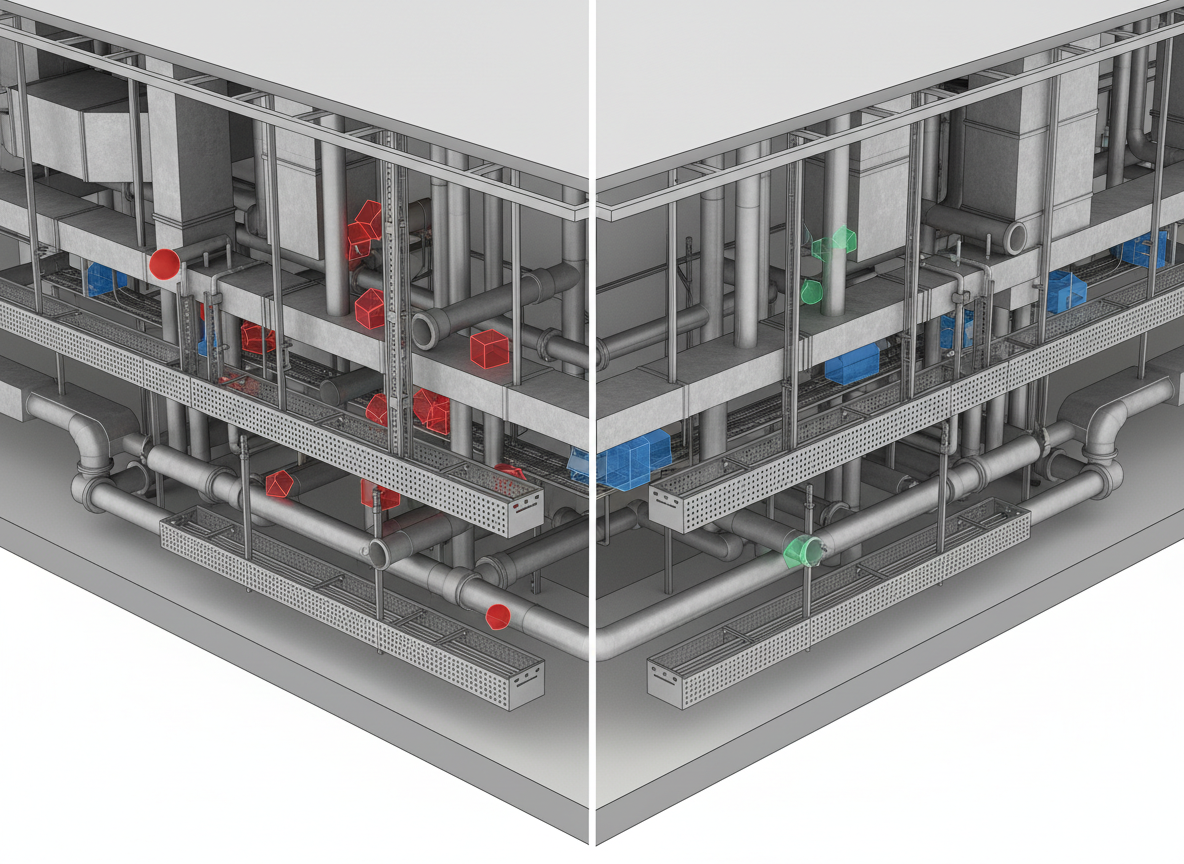
Impact of Challenges
- Programme overrun – Late-discovered clashes caused stop-start installation across trades, delaying handover.
- Variation cascade – Every on-site clash generated a variation, a revised drawing, and a programme delay – compounding floor by floor.
- Healthcare services compromised – Medical gas, theatre ventilation (HTM 03-01), and fire compartmentation routes reworked under site pressure.
- No federated model – Discipline models developed in isolation; first time trades were checked against each other was on the physical site.
- Cost exposure – Every on-site clash generated a variation order, revised drawings, and contractor standing time. The cumulative cost of late coordination across the previous project was significant and directly attributable to clashes that should have been resolved in the model.
Conserve Solutions - How We Solved It

a. Thinking (Strategy)
Healthcare MEP coordination cannot be a last-stage formality – medical gas, theatre ventilation, isolation room systems, and fire compartmentation all have non-negotiable routing requirements. We proposed structured coordination at RIBA Stage 4, treating it as a design-phase discipline rather than a pre-handover checkbox.
b. Execution (What We Built)
Audited and federated all discipline models (Architectural, Structural, Mechanical, Electrical, Plumbing, Fire Protection) in Navisworks Manage. Ran systematic clash detection across all intersections – MEP vs. Structure, MEP vs. Architecture, MEP vs. MEP. Classified every clash by severity: critical, major, or minor. Resolved each clash within the Revit models, with healthcare-specific services given routing priority in line with HTM and HBN requirements. Extracted coordination sections and MEP installation drawings from the verified model.
c. Integration (Impact Layer)
Delivered a clash-free federated model through the project’s Common Data Environment (Autodesk Docs), with structured clash reports, coordination sections for every ceiling void zone, riser, and plant room, and MEP installation packs that gave each trade a verified layout to build from – not a design intent, but a coordinated reference.
Before vs After Automation (High Impact Section)
Metric | Before | After | Improvement |
MEP Clashes | 1,200+ unresolved | Zero reaching site | ↓ 100% |
On-Site Variations (MEP) | Frequent – every clash = variation | Near zero | Variations eliminated |
Coordination Timing | 2 weeks before handover | RIBA Stage 4 | Design-phase discipline |
Model Federation | Never federated | Full Navisworks federation | All disciplines coordinated |
Healthcare Services | Reworked under site pressure | Routing priority protected | HTM/HBN compliant |
Installation Drawings | Uncoordinated design intent | Verified coordination packs | Build-ready reference |
Why Conserve Solutions
We don’t just run clash detection – we think, build, and integrate. From model audit to classified clash resolution to coordinated installation packs, we deliver the full coordination chain as one accountable process. Healthcare-specific services are given the routing priority they demand, not treated as secondary. The result is a federated model the construction team can trust before a single trade reaches site.
Client Outcome
“The difference was night and day. On the previous project, we were resolving clashes on-site every week. On this one, the MEP installation ran to programme from start to finish – no variations, no rework, no surprises.”
– Project Manager, Birmingham Healthcare Facility

Quick Links
Copyrights © 2026. Conserve Solutions. All Rights Reserved.
BIM Data, Cost & Handover Services
BIM Coordination & Constructability
BIM Modelling & Digital Delivery
Discipline BIM Modeling (Architectural, Structural, MEP)
BIM Automation & Digital Engineering
BIM Data, Cost & Handover Services
Structural & Steel Detailing Services
Architectural Design, Visualization & Presentation Support
BIM Coordination & Constructability
BIM Modelling & Digital Delivery