- Inspire
- Innovate
- Integrate

- Home
- Case Studies
- CFD Thermal Validation Eliminates Air Recirculation and Enhances Heat Rejection Efficiency in Cooling Towers
CFD Thermal Validation Eliminates Air Recirculation and Enhances Heat Rejection Efficiency in Cooling Towers
Project Snapshot
| Parameter | Details |
|---|---|
| Client | Residential Building |
| Sector | Residential |
| Location | Dubai |
| Platform / Software | Ansys CFX |
| Service Consultant | Conserve Solutions – Simulation & Analysis Division |
| Key Outcome | Cooling tower airflow validated; no inlet air recirculation observed; design wet-bulb conditions maintained; efficient heat rejection confirmed through CFD evaluation |
Problem Statement
We are experiencing higher-than-expected energy consumption and reduced cooling performance, likely due to hot air recirculation at the cooling tower inlet impacting system efficiency. A CFD analysis is required to better understand airflow behaviour and identify effective mitigation measures.
Impact of Challenges
- Airflow recirculation risk – warm discharge air entering the intake can significantly reduce cooling tower effectiveness.
- Cooling performance could drop – hot air recirculation can increase inlet air temperature, reducing overall heat rejection capacity.
- Cold water temperature may rise – failure to achieve design temperatures can impact chiller efficiency and downstream cooling systems.
- Energy consumption could increase – chillers and fans may work harder to compensate for reduced cooling effectiveness.
- Operational costs may increase – inefficient performance results in higher electricity usage and maintenance requirements.
Conserve Solutions - How We Solved It
a. Thinking (Strategy)
Conserve approached this problem by first reframing it from a performance complaint into a physics-driven question: how and where is hot air re-entering the system, and under what conditions does it become critical?
The CFD study quantified inlet temperature rise and identified key recirculation zones under real conditions. This made it possible to clearly connect airflow behaviour with performance loss. The insights enabled targeted design changes to reduce recirculation and improve efficiency.
b. Execution (What We Built)
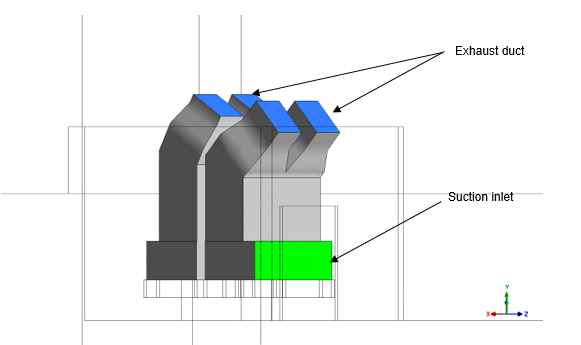
- Developed a high-fidelity 3D CFD model of the cooling tower system in Ansys CFX, incorporating tower geometry, fan characteristics, heat rejection loads, and surrounding site structures.
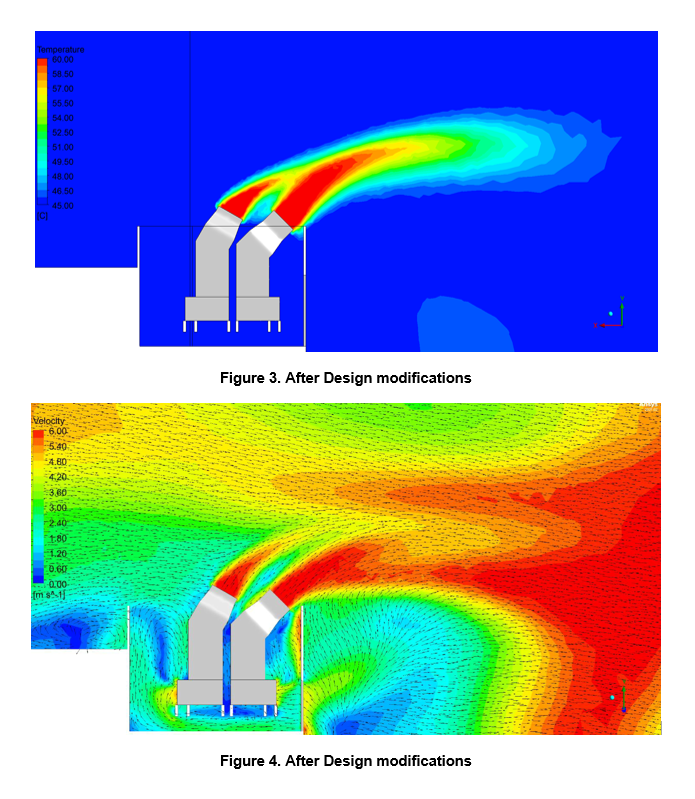
- Simulated two scenarios: (1) existing design to identify root causes of hot air recirculation, and (2) updated design to evaluate effectiveness of proposed mitigation measures.
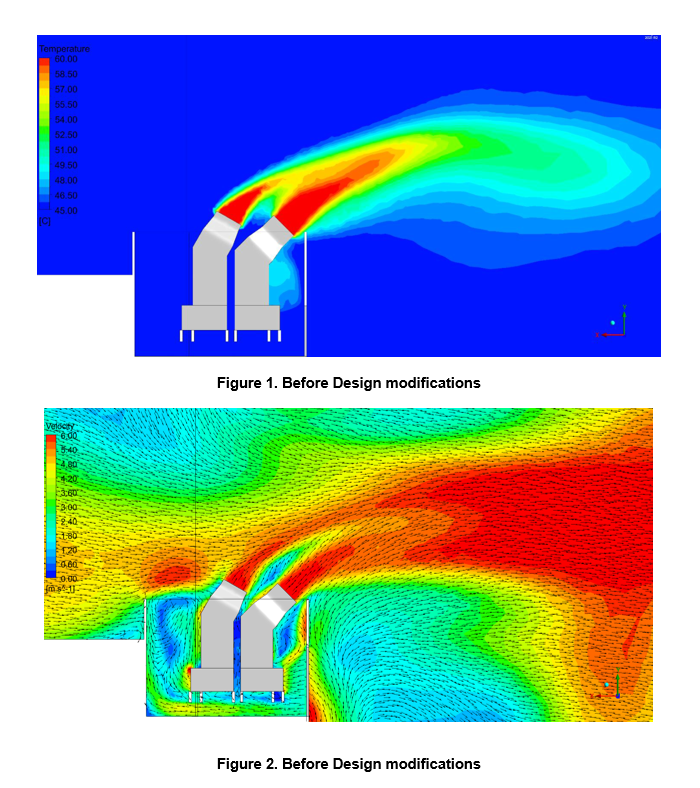
- Mapped cooling tower inlet air temperatures and compared them against design assumptions for thermal performance.
- Identified and quantified hot air recirculation zones and plume interaction between adjacent towers
- Evaluated the impact of ambient wind conditions on airflow distribution and recirculation intensity
- Assessed overall cooling efficiency degradation and validated performance against design and operational benchmarks
c. Integration (Impact Layer)
CFD results were translated into clear performance metrics, linking inlet temperature rise and recirculation directly to efficiency loss. The findings were structured into actionable design suggestions, supported by simulation outcomes as follows:
- Reduce uneven suction conditions at Cooling Tower due to airflow imbalance — resolved by introducing an additional opening to improve intake distribution and pressure conditions.
- Prevent warm exhaust air from re-entering the system — mitigated by elevating the return air discharge above the surrounding wall height, improving dispersion.
Project Timeline:
Phase 1 : Day 1 – 3 | Data collection, geometry modelling, boundary condition setup |
Phase 2 : Day 4 – 6 | CFD simulation runs (existing design + improved design), mesh refinement |
Phase 3 : Day 7 – 10 | Post-processing, ASHRAE validation, report preparation and delivery |
Delivered:
- Full 3D CFD model (Ansys CFX) – existing and revised cooling tower layouts under real operating conditions
- Temperature contour maps – cooling tower inlet zones highlighting hot air recirculation and ambient deviation
- Velocity vector and streamline plots – airflow behaviour, plume interaction, and recirculation patterns visualization
- Recirculation assessment summary – quantification of return air mixing and inlet performance impact
- Comparative performance evaluation – existing vs. optimized design thermal effectiveness and airflow improvement
- Design mitigation recommendations – louver optimization, opening adjustments, and return air discharge modifications
- Client-ready technical report with visual evidence and key findings
Software Used:
Ansys CFX | Primary CFD solver – thermal and fluid flow analysis |
ASHRAE TC 9.9 | Thermal compliance standard for data centre equipment |
Manufacturer ESP Curves | Cooling unit performance validation reference |
Before vs After (Measurable Difference)
| Metric | Existing Design Issue | After Validation | Improvement |
|---|---|---|---|
| Airflow Distribution at Cooling Tower Inlet | Uneven suction conditions due to airflow imbalance | Addition of extra opening improved intake distribution and pressure balance | More uniform airflow into cooling tower, improved cooling stability |
| Hot Air Recirculation | Warm exhaust air re-entering the cooling tower inlet | Raising discharge height above surrounding wall eliminated recirculation (CFD) | Prevented re-entrainment of hot air, improving inlet air quality |
| Cooling Performance / System Efficiency | Higher energy consumption and reduced cooling efficiency due to inlet temperature rise | CFD confirmed lower inlet temperatures and stable thermal performance | Restored cooling efficiency and reduced energy consumption under operating conditions |
Why Conserve Solutions
- We fix the root cause, not the symptom, through targeted geometry and airflow corrections.
- We validate improvements under real operating and wind conditions, not idealized cases.
- We ensure cooling towers achieve stable, design-level performance without costly field modifications.
Client Outcome
“Conserve’s CFD analysis helped clearly establish that the higher energy consumption and reduced cooling performance were linked to hot air recirculation and inlet airflow imbalance. Based on the findings, Conserve provided targeted measures to resolve the identified flow issues and enhance system performance under operating conditions. This enabled confident progression to final design with validated performance understanding.”

Quick Links
Copyrights © 2026. Conserve Solutions. All Rights Reserved.
BIM Data, Cost & Handover Services
BIM Coordination & Constructability
BIM Modelling & Digital Delivery
Discipline BIM Modeling (Architectural, Structural, MEP)
BIM Automation & Digital Engineering
BIM Data, Cost & Handover Services
Structural & Steel Detailing Services
Architectural Design, Visualization & Presentation Support
BIM Coordination & Constructability
BIM Modelling & Digital Delivery