- Inspire
- Innovate
- Integrate

- Home
- Case Studies
- Hotel Development – Outdoor Acoustic Validation Study
Hotel Development – Outdoor Acoustic Validation Study
Project Snapshot
Category | Details |
Client | Hotel Development in KSA |
Sector | Hospitality |
Location | KSA |
Platform / Software | CadnaA Software |
Standards | ISO 9613-1 & 2 standards |
Service | Conserve Solutions – Acoustics division |
Key Outcome | Developing effective acoustic mitigation strategies for multiple mechanical sources to ensure compliance with environmental noise limits across the development. |
Problem Statement
- The Hotel project required a comprehensive acoustic validation of all outdoor mechanical systems to ensure compliance with stringent noise criteria at site boundaries and sensitive guest areas.
- With complex topography, multi-level buildings, and a very high number of sound sources, the challenge was to accurately simulate real conditions and develop precise, cost-effective mitigation strategies
Impact of Challenges
- Complex Topography – Large terrain data with ~250 contour points per line created modelling limitations in the software.
- Non-Uniform Building Levels – Variations in building heights required manual interpretation and adjustment from drawings.
- High Source Count – Iterative simulations were required to avoid overdesign of the acoustic louver, resulting in cost reduction.
- Duct-Borne Noise Complexity – Equipment connected across multiple floors via ducts created challenges in noise prediction.
- Cost Risk – Group -based mitigation approaches could lead to overdesign and increased cost per equipment.
- Resource Limitation – Limited software license availability required efficient workflow planning.
Conserve Solutions - How We Solved It
a. Thinking (Strategy)
We adopted a practical and engineering-driven approach to simplify complex modelling challenges. Terrain contour limitations were overcome by converting them into height points for better flexibility. A receiver-based methodology was introduced to manage large source quantities efficiently. Each equipment was treated individually to ensure accurate and cost-effective mitigation rather than generalized assumptions.
b. Execution (What We Built)
- Converted terrain contour lines into height points to handle large topography data
- Manually adjusted building heights based on drawings for accurate modelling
- Developed a methodology to handle 400+ sources using receiver-based calculations
- Applied ASHRAE Chapter 49 and standard acoustic algorithms to evaluate duct-borne noise
- All noise-generating sources were individually analysed to optimize equipment-specific acoustic mitigation in accordance with project design requirements
- Optimized workflow to manage modelling with limited software license availability
c. Integration (Impact Layer)
- Provided mitigation solutions and practical recommendations for each equipment, including attenuation and dimensional requirements, to support effective project implementation.
- Reduced unnecessary cost by avoiding overdesign of acoustic elements.
Project Timeline:
Phase 1 : Day 1 – 10 | Data collection, baseline review, and initial model setup |
Phase 2 : Day 10 – 15 | Input Collection & Review – Finalising inputs |
Phase 3 : Day 16 – 26 | Acoustic modelling, handling complex sources, and simulation |
Phase 4 : Day 26 – 35 | Mitigation Analysis, Presentation with Mitigation Proposal |
Phase 5 : Day 35 – 45 | Revision on model considering Client and Other discipline feedbacks |
Software and Technology Used:
- CadnaA Software – Outdoor Noise Simulation – State of art software
- HVAC Noise Prediction Tool
Delivered - What we delivered:
Comprehensive Acoustic Validation Report includes:
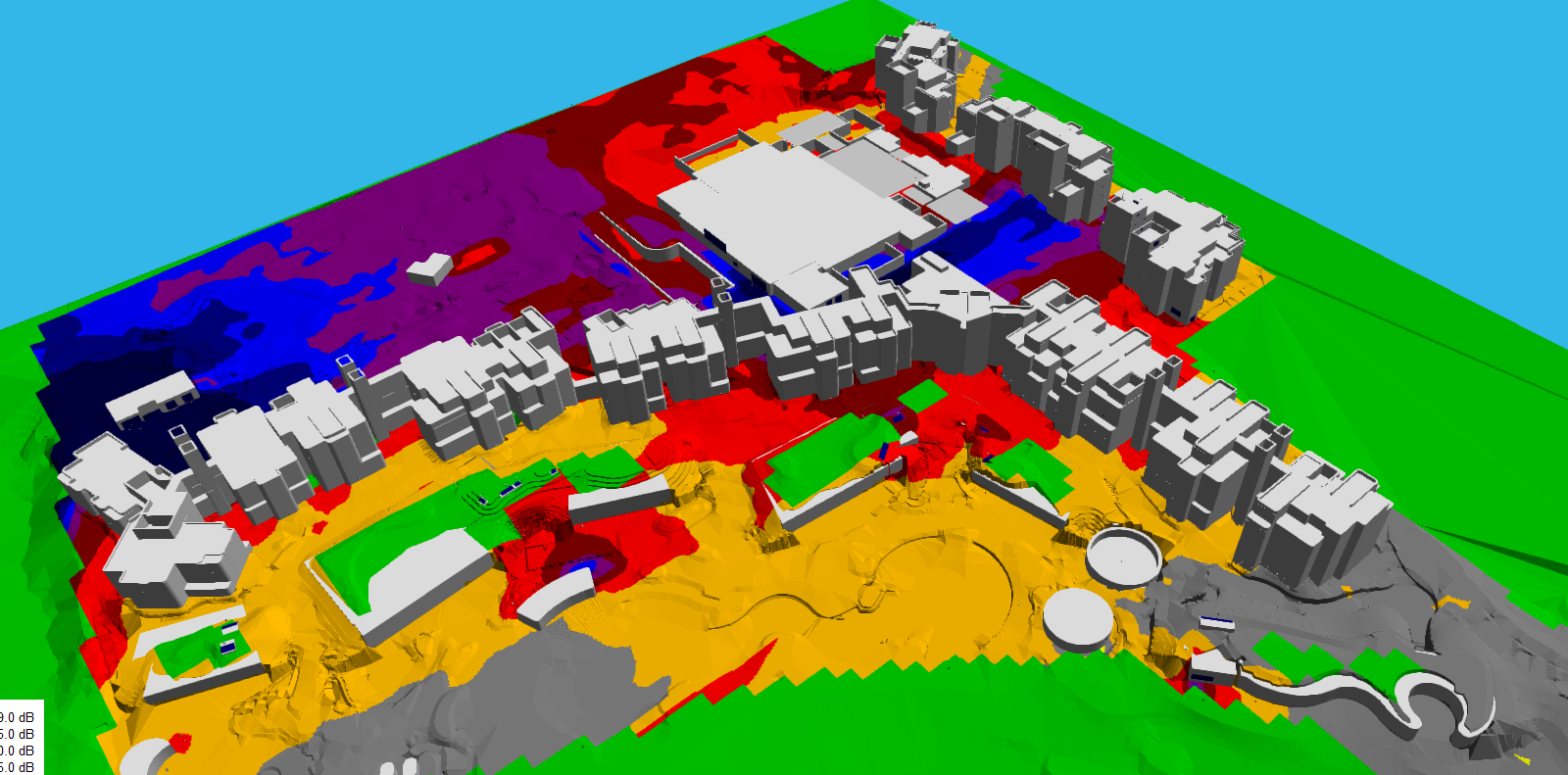
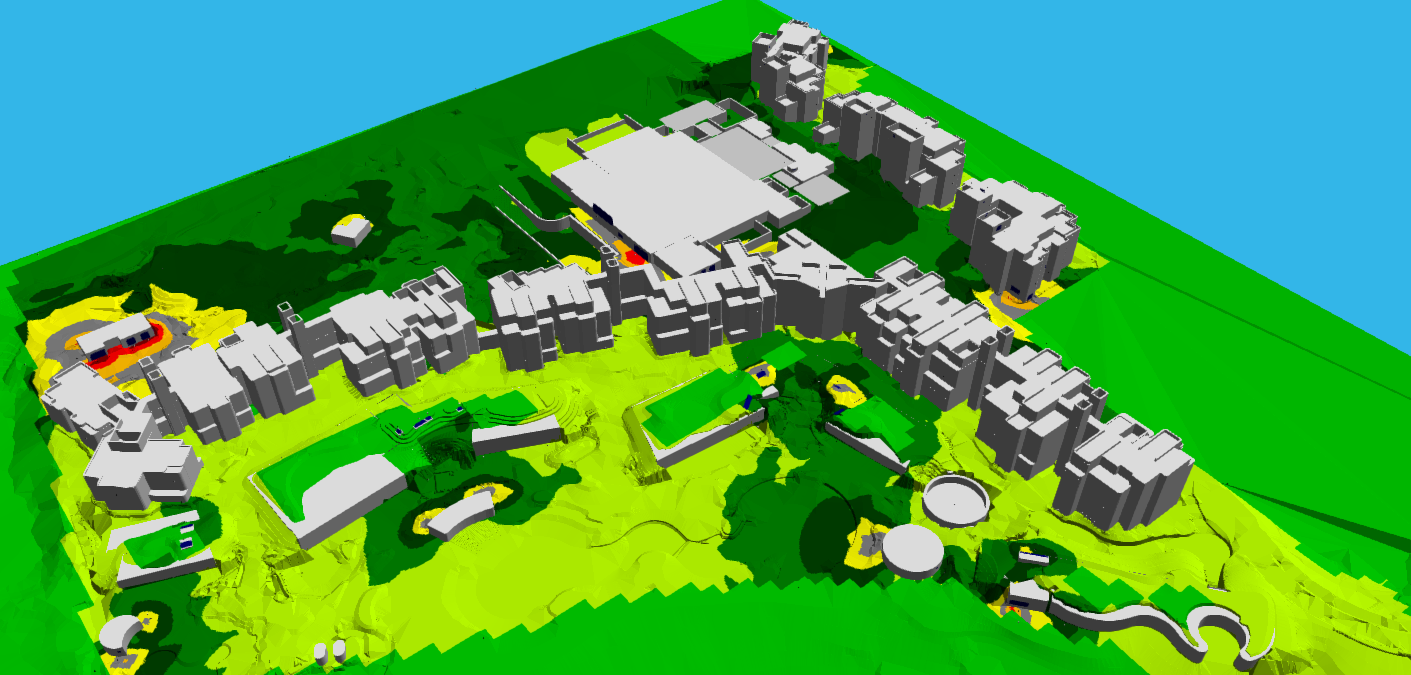
- Noise contour maps for the site boundary and sensitive receptors, including detailed simulations for 400+ mechanical sources.
- Compliance validation with project design requirements.
- Acoustic louver sizing and attenuation performance recommendations for critical equipment.
- Steel door acoustic rating (Rw) recommendations for transformer and generator rooms.
Before vs After | Mitigation – Measurable Noise Level Comparison
Noise Level Analysis | Before Mitigation (dBA) | After Mitigation (dBA) |
Environmental Noise (SPL) Level | 53 – 87 | < 45 |
External Noise within the development | 57 – 86 | < 55 |
Building Service Noise | 103 – 107 | ≤ 65 dBA @ 3m |
Why Conserve Solutions
- Innovative problem-solving approach for challenging mechanical and environmental noise control.
- Innovative methodology for handling large-scale acoustic models.
- Realistic Simulations – detailed Input Sound Data analysis leading to realistic/accurate noise simulations.
- Cost-Effective Solutions – Optimized acoustic recommendations across generators, transformers, HVAC systems, and architectural elements to achieve compliance without overdesign.
- Delivered high-quality outputs within limited resources and time.
- Practical and implementation-ready recommendations ensuring seamless coordination between design intent and site execution.
Client Outcome
The acoustic validation confirmed that all outdoor mechanical systems comply with the project noise criteria following the implementation of recommended mitigation measures, including steel doors with Rw 50 dB and appropriately designed acoustic louvers for generator, transformer, and exhaust applications. Early identification of critical noise issues and equipment-level solutions helped avoid overdesign and unnecessary costs. The project was delivered on time with high accuracy, ensuring a comfortable acoustic environment for guests and reliable system performance.

Gokul M
A Mechanical Engineer specializing in Architectural and Environmental Acoustics within the AEC industry, with experience in outdoor acoustic modelling, HVAC noise control, and environmental noise assessment. Passionate about applying acoustic engineering principles to develop practical, accurate, and cost-effective solutions for hospitality and large-scale developments. His expertise includes environmental sound analysis, acoustic mitigation strategies, noise mapping, and mechanical equipment noise control using CadnaA. He actively contributes to improving acoustic performance, occupant comfort, and multidisciplinary project coordination through engineering-driven acoustic solution

Quick Links
Copyrights © 2026. Conserve Solutions. All Rights Reserved.
BIM Data, Cost & Handover Services
BIM Coordination & Constructability
BIM Modelling & Digital Delivery
Discipline BIM Modeling (Architectural, Structural, MEP)
BIM Automation & Digital Engineering
BIM Data, Cost & Handover Services
Structural & Steel Detailing Services
Architectural Design, Visualization & Presentation Support
BIM Coordination & Constructability
BIM Modelling & Digital Delivery