Environmental acoustic compliance has become a critical design parameter in modern data Centre development due to the continuous operational nature of these facilities and the significant mechanical noise generated by essential infrastructure systems. Data centers operate 24/7 to support cloud computing, digital services, and global data exchange, resulting in a constant noise output from equipment such as chillers, cooling towers, generators, transformers, and HVAC systems. These sources often produce steady-state or tonal noise characteristics that can propagate beyond site boundaries and influence surrounding environments.
In this Blog
Introduction
Key Takeaways
Regulatory Framework and Noise Limits
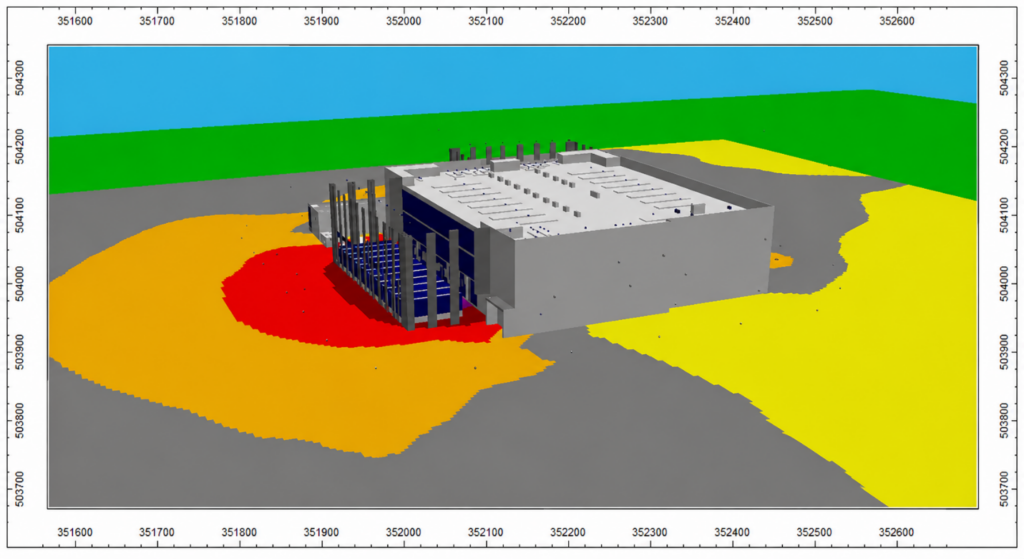
Role of Acoustic Design and Predictive Modelling
Conclusion
Key Takeaways
Acoustic design is essential for environmental compliance in continuously operating data centers
Mechanical systems such as chillers, pumps, generators, and HVAC are major contributors to environmental noise impact
Predictive acoustic modelling enables early identification and mitigation of noise risks before construction.
Proper mitigation planning significantly reduce redesign costs and regulatory delays/penalty.
Regulatory Framework and Noise Limits
In most countries, environmental noise is governed by strict regulatory frameworks that define permissible sound levels for different land uses and time periods. Environmental regulatory authorities establish daytime and nighttime noise limits to protect residential, commercial, and noise-sensitive receptors such as schools, hospitals, and community zones. These standards are mandatory in nature and form a key requirement within planning approval processes, directly influencing whether a project is approved, modified, or rejected.
For data centers, compliance with local acoustic guidelines is essential to avoid community complaints, operational restrictions, work hour limitations, regulatory penalties, and reputational risk. Since data centers operate continuously with major mechanical and electrical equipment, failure to control environmental noise may result in additional mitigation requirements imposed at later project stages. Therefore, acoustic compliance is a key prerequisite for smooth planning approval, sustainable operation, and reduced environmental impact on surrounding communities.
Figure 1- Noise Simulation of a Data Center for the One of our Projects
Is Acoustic Comfort a Challenge on Your Current Project?
Early identification of potential noise exceedances
Optimization of plant layout and equipment positioning
Evaluation of mitigation measures such as barriers, enclosures, and acoustic louvres
Scenario-based comparison of alternative design configurations
Reduction of late-stage redesign and mitigation costs
Improved coordination between architectural, structural, and MEP disciplines
Stronger technical evidence for planning submissions
As data Centre developments continue to increase in scale and power density, acoustic design is no longer a secondary consideration but an integral engineering discipline that ensures regulatory compliance, operational continuity, and environmental responsibility.
Conclusion
As data Centre developments continue to increase in scale, capacity, and power density, acoustic performance can no longer be treated as a secondary consideration. Instead, it has become an integral component of the overall engineering design process.
Effective acoustic design ensures that environmental noise impacts are identified and controlled at an early stage, reducing technical risk, avoiding regulatory delays, penalties and preventing costly redesign during later project phases. More importantly, it enables data centers to operate continuously while maintaining compliance with environmental standards and minimizing disturbance to surrounding communities.
In this context, acoustic engineering supports not only regulatory approval but also long-term operational resilience, sustainable development, and responsible integration of critical digital infrastructure within the built environment.
Need expert acoustic support for your data centre development?
Our team provides predictive noise modelling, compliance assessments, and mitigation strategies to help deliver environmentally responsible and regulation-compliant facilities.
Yowan Benet is a Mechanical Engineering graduate currently working as an Acoustic Consultant. He has experience in HVAC noise assessment and environmental noise assessment, with involvement in acoustic analysis, compliance evaluations, and technical reporting for various projects.