- Inspire
- Innovate
- Integrate

- Home
- Case Studies
- Revit-Native MEP Coordination for 280 Apartments in Manchester – Clash-Free IFC Issued 3 Weeks Ahead of Programme
Revit-Native MEP Coordination for 280 Apartments in Manchester – Clash-Free IFC Issued 3 Weeks Ahead of Programme
Project Snapshot
Parameter | Detail |
Client | Main Contractor – Residential Conversion (280 Units) |
Sector | Commercial to Residential |
Location | Manchester, United Kingdom |
Platform / Software | Autodesk Revit, Navisworks Manage, Autodesk Docs |
Standards | BS EN ISO 19650, UK BIM Framework, RIBA Stage 4 |
Service | MEP BIM Coordination, Typical Unit Methodology, Clash Resolution, IFC Delivery |
Key Outcome | Clash-free coordinated IFC issued 3 weeks ahead of programme |
Problem Statement
Nobody coordinates 280 apartments. They coordinate the typical units, then prove the logic stacks across every floor. On a Manchester residential conversion, that structure wasn’t there. Each apartment had been modelled and coordinated individually – inconsistent service routes, inconsistent ceiling void strategies, and no prototype driving the repeat. By Stage 4, the model was producing hundreds of clashes and the main contractor could not issue construction packages from it.
Impact of Challenges
- No typical-unit prototype – Each apartment had been modelled in isolation rather than against a coordinated typical layout, producing inconsistent routing across units of the same type.
- Risers didn’t stack – Without a propagated typical, vertical service risers drifted between floors – misaligned core penetrations and discontinuous riser routes at every level transition.
- Ceiling voids uncoordinated – Ductwork, pipework, and containment shared the same void depth with no spatial hierarchy, repeated inconsistently across units.
- Cost exposure – On a 280-unit scheme, uncoordinated MEP cascades into abortive work, delayed ceiling closures, and knock-on delays across follow-on trades. The exposure scaled with the building.
Conserve Solutions - How We Solved It
a. Thinking – The Typical Unit Methodology (Strategy)
Residential coordination is a propagation problem, not a volume problem. The 280 units resolved into seven typical apartment types. Our approach was to coordinate each typical type once – to a defined standard, fully clash-free – then propagate it across the building and verify the stacking works floor by floor. Solve seven layouts properly, not 280 individually.
b. Execution – Prototype, Propagate, Verify (What We Built)
Classified the 280 units into seven typical apartment types and set each one up as a coordinated prototype. Within each prototype, defined the ceiling void with fixed clearances and access zones. Fixed the riser positions against the architectural core so vertical services stacked cleanly floor to floor. Once each prototype was clash-free against structure and architecture, we propagated the typical layouts across the tower using Revit groups and model links so every instance inherited the coordinated routing. Ran floor-by-floor verification through Navisworks to catch edge conditions at ground floor, plant deck, and roof levels where the typical breaks down. Resolved the atypical floors in targeted rounds until the full model was clash-free.
c. Integration – A Coordinated Repeat (Impact Layer)
Issued the coordinated IFC three weeks ahead of the Stage 4 milestone. The main contractor received a clash-free federated set with a documented typical-unit specification, meaning every future design change could be made once at the prototype level and propagated with confidence – not coordinated again from scratch across 280 units.
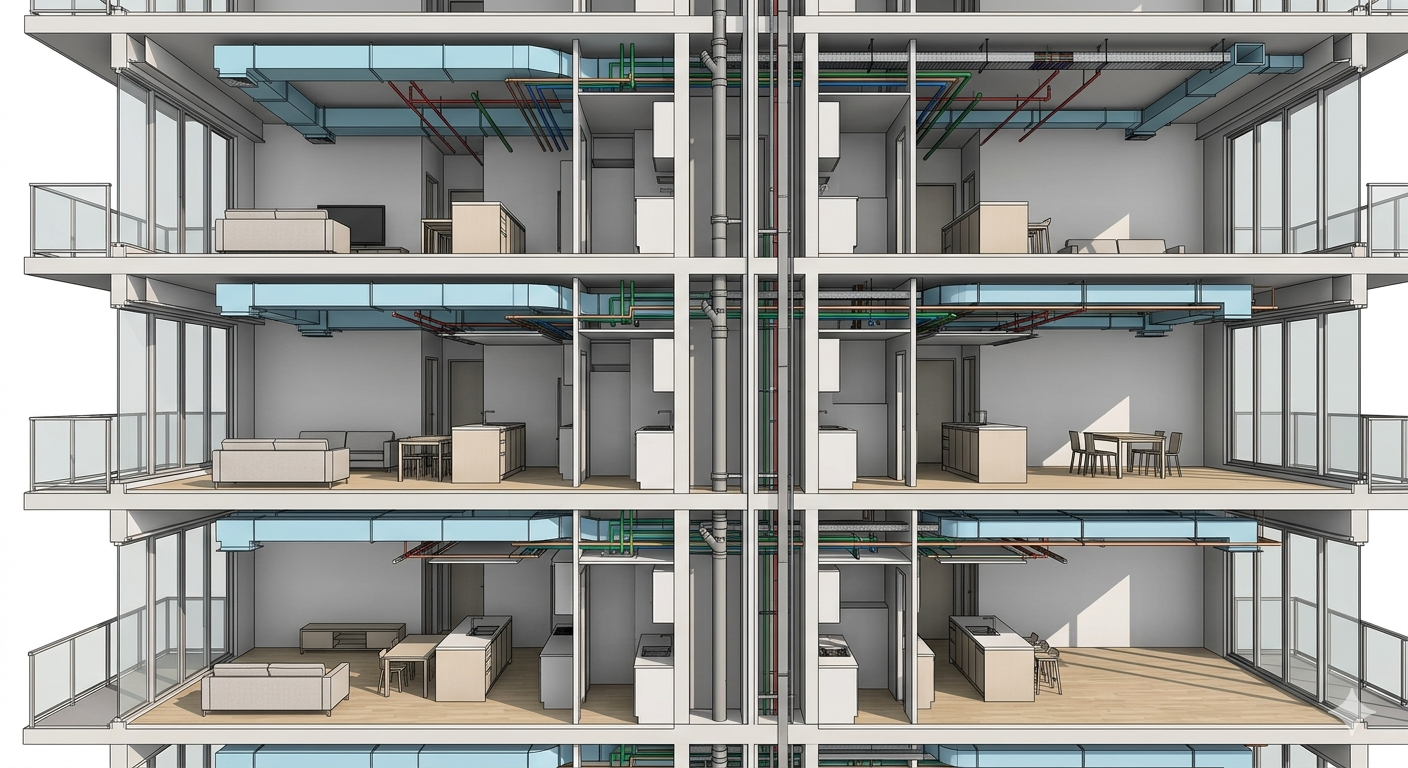
Before vs After Automation (High Impact Section)
Metric | Before | After | Improvement |
Coordination Basis | 280 units coordinated individually | 7 typical prototypes propagated across building | Scalable methodology |
Riser Stacking | Drift at every floor transition | Stacked cleanly against architectural cores | Vertical continuity |
Ceiling Voids | No service zone hierarchy | Defined zoning applied to every typical | Consistent routing |
Clash Status | Hundreds across every floor plate | Zero critical clashes | Clash-free IFC |
Change Management | Any edit repeats across 280 units | Edit the prototype, propagate the change | Future-proofed |
IFC Delivery | At risk of delay | Issued 3 weeks ahead of programme | 3-week buffer |
Why Conserve Solutions
On a repetitive residential scheme, coordination should scale with the building – not fight against it. We treat the typical unit as the engineering problem and the tower as its repetition. Get the prototype right, propagate it properly, and verify where the pattern breaks. That’s how a 280-unit scheme delivers clash-free and ahead of programme.
Client Outcome
“Conserve reframed the whole coordination – instead of chasing clashes unit by unit, they set up the typicals properly and let the building inherit them. We got a clean IFC three weeks early and a model we can actually manage future changes in.”
– Project Manager, Main Contractor, Manchester

Quick Links
Copyrights © 2026. Conserve Solutions. All Rights Reserved.
BIM Data, Cost & Handover Services
BIM Coordination & Constructability
BIM Modelling & Digital Delivery
Discipline BIM Modeling (Architectural, Structural, MEP)
BIM Automation & Digital Engineering
BIM Data, Cost & Handover Services
Structural & Steel Detailing Services
Architectural Design, Visualization & Presentation Support
BIM Coordination & Constructability
BIM Modelling & Digital Delivery