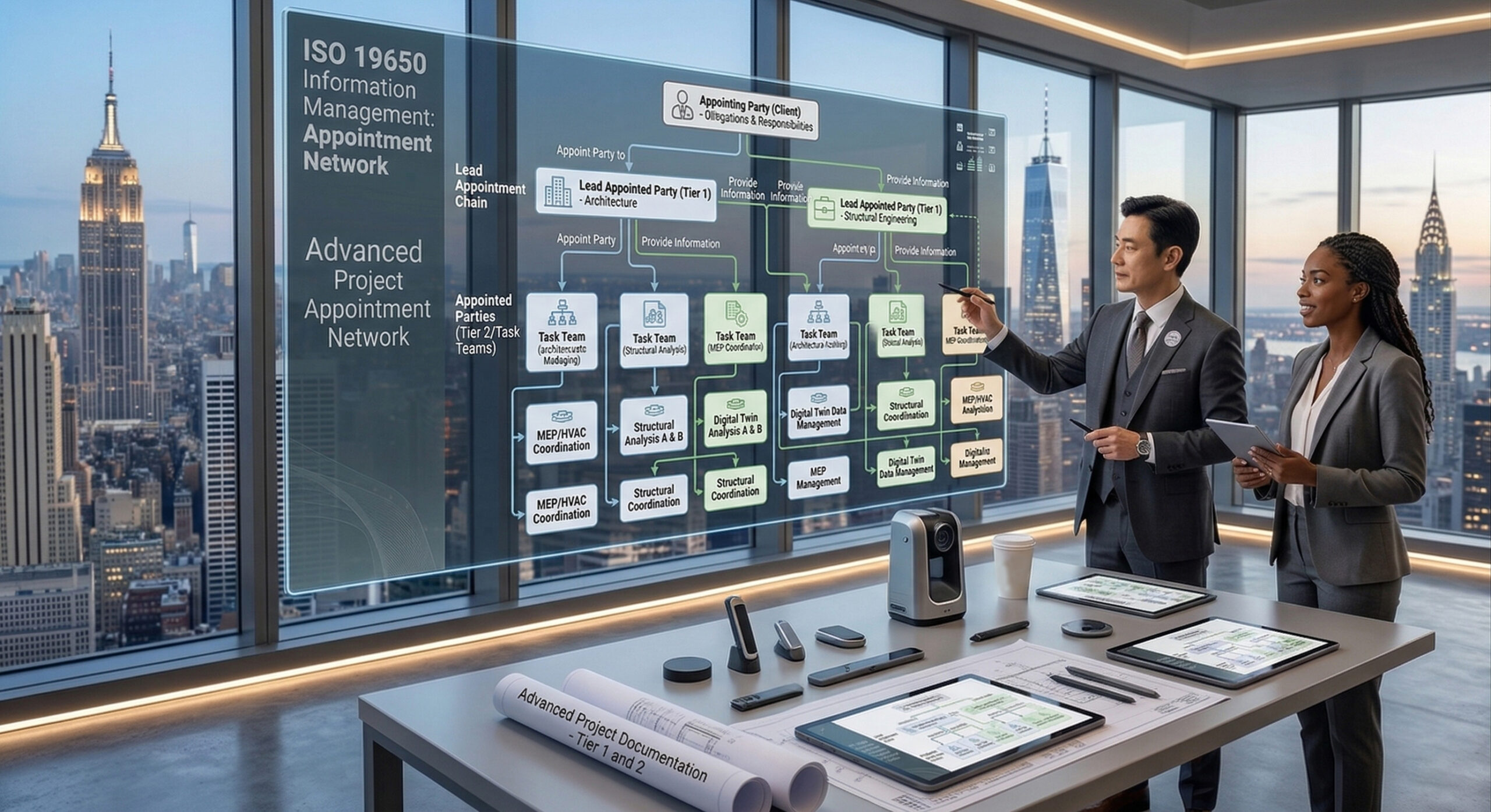



Building Information Modelling (BIM) is the structured process of creating and managing digital information about a built asset throughout its life cycle. In the UK, it is applied across commercial, healthcare, residential, and infrastructure projects – and is a contractual requirement on publicly funded schemes under BS EN ISO 19650. As BIM becomes standard practice, the question is not whether to use a BIM service provider, but how to identify one whose process, standards fluency, and quality controls will hold up under live project conditions.
Most appointments are made on two criteria: software licences and day rate. Both tell you very little about whether the model you receive will be construction-ready, stage-aligned, and usable in a federated environment without a correction exercise. This blog sets out the six criteria that should sit alongside – and often above – price and software in any BIM procurement decision.
The following six criteria address the process, standards knowledge, and quality disciplines that determine whether a BIM provider can genuinely deliver – not just model. They apply whether your project is a single-discipline architectural model in Manchester or a multi-discipline coordination role on a large commercial scheme in London.
BS EN ISO 19650 is the UK’s governing standard for information management over the life cycle of a built asset. On any project where BIM is a contractual requirement, your provider must demonstrate genuine fluency with this framework – not just familiarity with the acronym. In practice, this means three things: they must be able to read and respond to an Employer’s Information Requirements (EIR) document; they must be able to produce or contribute to a pre-contract BIM Execution Plan (BEP); and they must understand their obligations as a Task Team within the project’s information management structure. Ask directly: have they worked on ISO 19650-appointed projects? Can they share a BEP they have produced? A provider who is genuinely fluent will ask for your EIR at the first meeting – before they quote.
Under the RIBA Plan of Work 2020, each project stage has defined information exchanges. A provider who cannot describe what their model should contain at RIBA Stage 2 (Concept Design), Stage 3 (Spatial Coordination), or Stage 4 (Technical Design) is producing geometry, not managing information. The practical consequence of stage misalignment is a model that is technically complete but does not contain the information your consultant team or contractor needs at the point they need it. Ask: ‘If we are at RIBA Stage 3, what should the model contain, and what would you not include until Stage 4?’ A confident, specific answer confirms stage fluency.
Model quality is not a subjective judgement. In a well-run BIM practice, it is a measurable standard: no overlapping geometry, correct workset structure, compliant naming conventions, accurate level and grid setup, clean IFC export, and element properties populated to the agreed Level of Information Need (LOIN). Ask how they define quality – and specifically who checks the model before it is issued. The answer should describe a structured internal review process, ideally conducted by someone other than the modeller. At Conserve Solutions, every model passes a documented second-eye review against the EIR and agreed LOIN before it enters the CDE. Clients receive a model quality summary with every issue.
On any project involving more than one discipline, the BIM model does not exist in isolation. It is one layer of a federated model, assembled in a Common Data Environment (CDE) and coordinated against the outputs of other task teams. A provider who has only produced single-discipline models will introduce problems that only become visible when the federated model is assembled: inconsistent gridlines, wrong model origin, elements that clash with structure because spatial coordination was not managed as a live process. Ask what CDE platforms they have used – Autodesk Construction Cloud, Asite, Aconex, or others common on UK projects. Ask how they manage BCF issues and model freeze dates.
BIM modelling is not a silent, self-contained exercise. On any live project, the modeller will encounter ambiguities and decisions that require input from the design team or client. How a provider manages these situations has a direct impact on programme. Ask how design queries are raised and tracked. Is there a formal query log? Are queries issued through the CDE or by email? What is the expected response time, and what happens if a query is not resolved within that window? Who is your named contact, and what is their availability? Agree response time commitments in writing at appointment.
A portfolio shows output. A reference reveals process, reliability, and what it is actually like to work with this provider under programme pressure. When requesting references, be specific: a BIM modelling appointment for a residential scheme in Manchester has different demands from a multi-discipline coordination role on a commercial refurbishment in London. Ask references two questions: did the model meet the information requirements agreed at appointment? And was the provider proactive in raising and resolving issues – or did problems only surface when others found them? The second question is the more revealing of the two.
Knowing what good looks like is important. Knowing what poor looks like is equally important – and often faster to identify in an initial conversation. The following warning signs should give any appointing team pause before issuing an appointment letter.
They are not operating within the ISO 19650 framework. On any project where BIM is a contractual requirement, this is a baseline disqualifier.
A scope has been assumed, not defined. Variations are almost guaranteed. Rework is probable.
There is no structured, documented quality control. Model errors will surface at the CDE gate – or after the contractor has started building from inaccurate data.
They have not functioned within a coordinated, federated BIM environment. Your project will be the first time they learn. You will pay for that learning.
If references cannot confirm that the model met the EIR, was delivered at the right RIBA stage, and passed the CDE quality gate, the reference is not useful to your appointment decision.
Software is the tool, not the skill. A provider who leads with ‘we have full Autodesk licences’ has not understood what you are actually buying.
Quality BIM delivery in the UK sits within a defined standards framework. A provider working to that framework is not doing more than required – they are doing what is required. The following are the standards every competent UK BIM provider should be operating within.
The international standard for information management over the life cycle of a built asset using BIM. It governs how information is structured, named, exchanged, and archived across the project team. Fluency with ISO 19650 is the baseline competency requirement for any UK BIM provider working on projects where BIM is a contractual obligation.
The definitive UK framework for project stages 0–7. BIM models must be scoped against the specific stage they are intended to support, with information requirements defined accordingly at each stage transition. A provider who cannot align their deliverables to RIBA stages is not managing information – they are producing output.
The EIR is the client’s formal statement of information requirements. The BEP is the appointed party’s response. Together, they define the contractual basis for BIM delivery on a project. A provider who has never been asked for a BEP, or who cannot produce one, is not operating within the ISO 19650 appointment framework.
The single, managed digital environment through which all project information is created, reviewed, approved, and shared. On ISO 19650 projects, models and documents move through defined information states – Work in Progress, Shared, Published, and Archived. Common CDE platforms on UK projects include Autodesk Construction Cloud (ACC), Asite, Aconex, and Viewpoint. CDE familiarity is not optional on any multi-discipline project.
Introduced under ISO 19650, LOIN defines precisely what graphical and non-graphical information is required at each stage and for each use case. It replaces generic LOD descriptions with a defined, contractually referenced information standard. A provider who defaults to LOD language without referencing LOIN is working to an outdated information framework.
Every BIM project in the UK begins with an appointment. That appointment either establishes a well-managed information environment or creates a problem the rest of the team spends the programme managing around. The difference is rarely visible at procurement stage – it becomes visible when the federated model is assembled, when the CDE quality gate is applied, or when the contractor opens a model that does not reflect the building as designed.
The six criteria in this blog give appointing teams a basis for evaluating BIM providers on process, standards fluency, and professional discipline – not just price and software. As ISO 19650 adoption deepens across the UK supply chain and LOIN-referenced information requirements become contractually standard, the gap between providers who work to the framework and those who do not will become increasingly consequential.
Software is a given. Price is a constraint. What you are actually buying is process, judgement, and professional discipline. Those are worth asking about before the appointment letter is signed.
Conserve Solutions provides ISO 19650-aligned BIM services across London, Birmingham, Manchester, Leeds, and the wider UK - from RIBA Stage 2 through to Stage 6 handover. Every appointment begins with a review of your EIR. Every model is independently checked before it enters your CDE.
We work to your EIR, follow your BEP, and deliver models your design team and contractor can actually use at the right stage, with the right information, at the right tolerance.
Author

An Emerging International Business Developer in the AEC Industry. Shankar is a Mechanical Engineer from India with a specialization in Mobility Engineering from the esteemed Politecnico di Milano University, Milan, Italy. Shankar is dedicated on exploring business opportunities in the Built Environment / BIM. He focuses on International Business Development Operations globally. He supports Team Conserve by Introducing New Client, Project Collaborations, Brand Awareness, New technology tool integrations and New Portfolio Creations.
Copyrights © 2026. Conserve Solutions. All Rights Reserved.
BIM Data, Cost & Handover Services
BIM Coordination & Constructability
BIM Modelling & Digital Delivery
BIM Automation & Digital Engineering
BIM Data, Cost & Handover Services
Structural & Steel Detailing Services
Architectural Design, Visualization & Presentation Support
BIM Coordination & Constructability
BIM Modelling & Digital Delivery