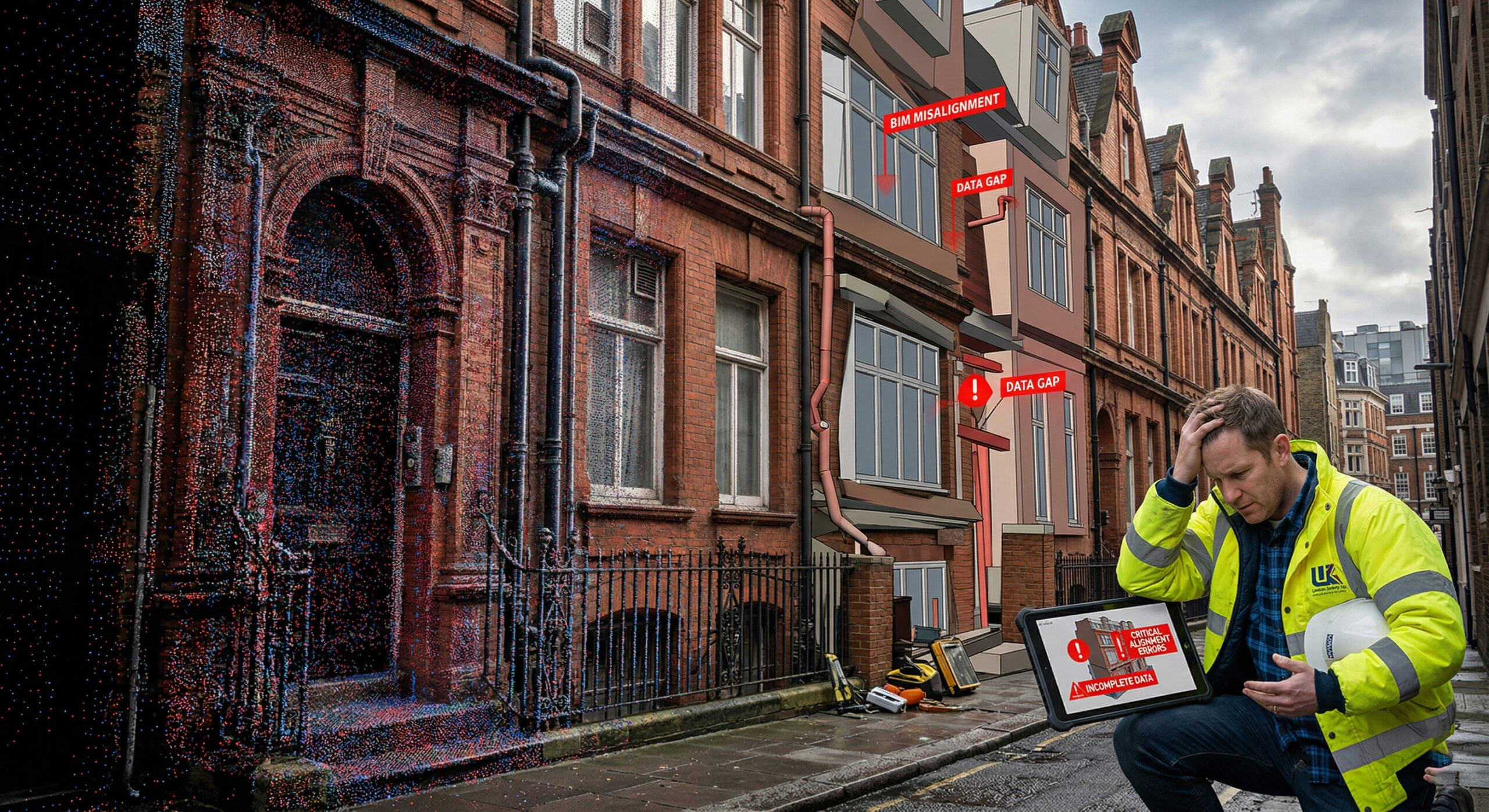



Scan to BIM is the process of converting laser-scanned point cloud data into an intelligent, structured Building Information Model – typically in Autodesk Revit. It is applied across UK refurbishment, retrofit, heritage, and infrastructure projects where accurate existing-conditions data is essential before design begins. As BIM adoption accelerates under UK Government mandates and BS EN ISO 19650, the quality of the Scan to BIM model directly determines how reliably design and coordination can proceed.
Appointing a Scan to BIM provider on price alone is one of the most common – and costly – mistakes made on UK projects. A poor-quality model creates rework that is invisible on any invoice but visible in every downstream deliverable. This blog sets out what to evaluate before you appoint, the warning signs to look for, and the standards that define quality delivery.
Correcting a poor-quality Scan to BIM model typically costs three to five times what a properly specified appointment would have. The rework is invisible on any invoice – it shows up as programme delay, additional design fees, and a design team working from data they cannot fully trust.
Before inviting any Scan to BIM provider to quote, there are seven specific quality indicators every appointing team should evaluate. These are not administrative exercises – they are the practical difference between a model your design team can use immediately and one that requires costly correction before it can support any downstream work.
The laser scan is the foundation of everything that follows. A dense-looking point cloud can still contain registration errors that make it unreliable for detailed modelling. Ask for a scan registration report confirming that individual scan stations have been stitched together accurately and verified against site control points. For professional-grade work, the accuracy tolerance should be stated: typically ±2mm to ±5mm depending on method and purpose. At Conserve Solutions, every project deliverable includes a scan registration report as standard.
Generic Revit families are the most frequent source of downstream frustration. On existing buildings – Victorian warehouses, 1960s office blocks, period residential conversions – standard library families are often simply wrong. When non-standard elements are modelled with generic families, your design team must either trust inaccurate data or rebuild from scratch. Ask to see examples of how the provider handles non-standard geometry. Look for evidence of custom family creation, not placeholder substitution.
In UK BIM practice under BS EN ISO 19650, model requirements are defined by RIBA Plan of Work stage – not by a generic LOD number. The information required at RIBA Stage 3 (Spatial Coordination) differs significantly from Stage 4 (Technical Design) or Stage 6 (Handover). This is captured formally through the Level of Information Need (LOIN), set out in the Employer’s Information Requirements (EIR). Confirm which RIBA stage the model needs to support and whether your project has a formal EIR before inviting quotes.
On any project where the Scan to BIM model feeds into a coordinated, federated BIM environment, the provider needs to understand how a model behaves in that environment. Ask whether they are familiar with Common Data Environment (CDE) protocols, IFC export requirements, and the ISO 19650 workflow. A provider who has worked on coordinated projects will know why model origin points, shared coordinates, and consistent naming conventions matter.
Every professional provider should verify their model against the point cloud before issue. The check should confirm that modelled elements correspond to actual site conditions within the agreed tolerance, that no elements are missing, and that the model is structurally sound. Ask specifically: is the check done by the same person who built the model, or by a second reviewer? At Conserve Solutions, every model is independently reviewed by a second team member before issue.
Existing buildings contain surprises. Access restrictions, hidden voids, structural elements in unexpected locations – all of these can require additional scan positions or model updates. Before signing, establish clearly what the quoted fee covers, what triggers a variation, and what a return site visit costs. A provider who is transparent about scope boundaries is far less likely to raise unexpected variations mid-project.
Ask for the name and contact of a project manager, architect, or structural engineer on a comparable completed project – same building type, similar complexity, similar RIBA stage. A provider confident in their quality will provide this without hesitation. References that cannot speak to specific technical quality should be treated with caution.
Knowing what good looks like is important. Knowing what poor looks like is equally important – and often easier to identify quickly in an initial conversation.
The point cloud has not been formally validated. Errors may not surface until your design team tries to work from the data.
A provider who leads with cost before understanding the building, RIBA stage, or end use is estimating, not pricing. Scope creep follows.
Existing buildings – especially heritage, industrial, or multi-storey residential – require significantly more skill than a standard new-build survey. Verify that experience is genuinely relevant.
If the person answering cannot describe how the model is checked before issue, there is no formal QC process. The risk transfers to the appointing team.
On any project operating under UK BIM practice, this is baseline knowledge. A provider unfamiliar with these frameworks will need to learn them on your project.
Quality Scan to BIM delivery in the UK does not operate in isolation. It sits within a defined standards framework that every professional provider should be operating within.
The international standard for managing information over the whole life cycle of a built asset using BIM. It defines how information should be structured, named, exchanged, and archived across a project team. Any Scan to BIM provider working on UK projects should be familiar with its requirements.
The definitive UK framework for project stages 0–7. Scan to BIM models must be scoped against the specific stage they are intended to support, with information requirements defined accordingly.
Introduced under ISO 19650, LOIN replaces generic LOD descriptions with a precise definition of what information – graphical and non-graphical – is required at each stage and for each purpose. A provider who cannot discuss LOIN is not working to the current UK standard.
The CDE is the single source of truth for project information on a BIM project. Scan to BIM deliverables should be issued and managed through an agreed CDE, with the provider familiar with the protocols that govern it.
Conserve Solution delivers accurate, construction-ready Scan to BIM services across London, Manchester, Birmingham, Glasgow, and the wider UK. Every model is verified against the point cloud before it leaves our team.
The quality of a Scan to BIM appointment determines the reliability of every downstream deliverable that depends on it. In a UK construction environment where BIM is increasingly contractually mandated and coordination increasingly federated, the cost of a poor-quality model extends far beyond the correction exercise itself – it affects programme, design fees, and the confidence of every team member working from that data.
The seven checks and five warning signs in this blog are the practical starting point for any appointment process. As UK BIM practice continues to mature, the expectation on providers will only rise – LOIN compliance, CDE integration, and formally verified deliverables will become baseline requirements rather than differentiators.
A properly appointed Scan to BIM provider delivers a model your team can open and use immediately – one that reflects the building accurately, supports the right RIBA stage, and holds up through the coordination process. That outcome is achievable. It starts with asking the right questions before the appointment letter is signed.
Author

An Emerging International Business Developer in the AEC Industry. Shankar is a Mechanical Engineer from India with a specialization in Mobility Engineering from the esteemed Politecnico di Milano University, Milan, Italy. Shankar is dedicated on exploring business opportunities in the Built Environment / BIM. He focuses on International Business Development Operations globally. He supports Team Conserve by Introducing New Client, Project Collaborations, Brand Awareness, New technology tool integrations and New Portfolio Creations.
Copyrights © 2026. Conserve Solutions. All Rights Reserved.
BIM Data, Cost & Handover Services
BIM Coordination & Constructability
BIM Modelling & Digital Delivery
BIM Automation & Digital Engineering
BIM Data, Cost & Handover Services
Structural & Steel Detailing Services
Architectural Design, Visualization & Presentation Support
BIM Coordination & Constructability
BIM Modelling & Digital Delivery