Most UK project teams believe they are doing BIM coordination. They run a Navisworks clash report, send it around, mark some items resolved, and move on. What they are actually doing is clash detection – and the gap between detection and genuine coordination is where variation orders are born, programmes slip, and contractors lose faith in the BIM model entirely. Projects that close this gap are delivering on time, with fewer on-site surprises and lower overall cost. Projects that do not are paying for it – repeatedly, invisibly, and avoidably. This article explains precisely what is missing and what it takes to fix it.
In this Blog:
1. Key Takeaways 2. Clash Detection vs BIM Coordination: The Real Difference 3. What UK Projects Are Losing Right Now 4. The Coordination Framework That Closes the Gap 5. Conclusion
02. Clash Detection vs BIM Coordination: The Real Difference
Clash detection is a function. BIM coordination is a process. The distinction matters enormously in practice, and conflating the two is one of the most expensive misunderstandings in UK construction today.
What clash detection does
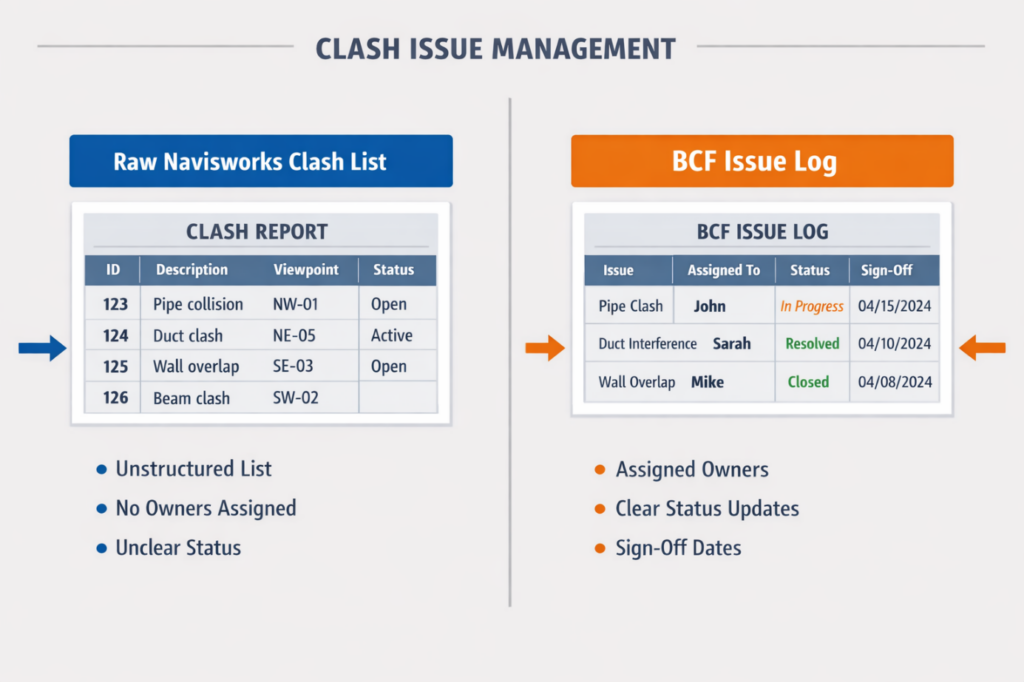
A clash detection exercise – typically run in Autodesk Navisworks – identifies geometric conflicts between elements in a federated model. A duct that intersects a beam. A pipe that runs through a column. A light fitting positioned inside a ceiling void with no clearance. The software surfaces these conflicts as a list of hard and soft clashes. That list is the output. Detecting the clash is where most teams stop.
What BIM coordination actually requires
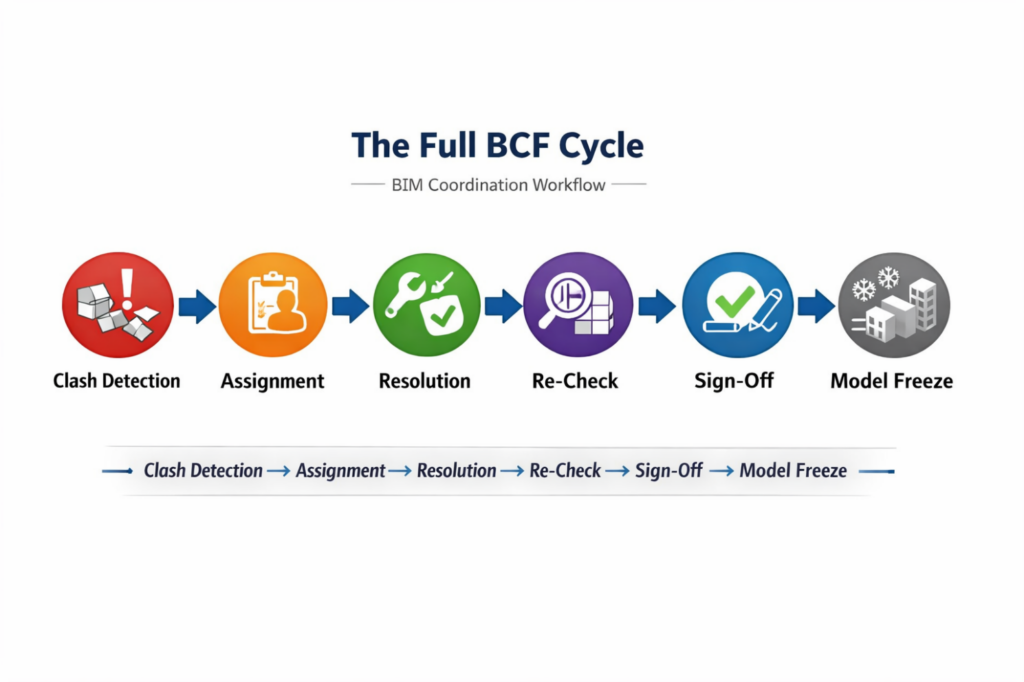
Genuine BIM coordination under BS EN ISO 19650 goes substantially further. It requires a structured process in which every clash is assigned to a named owner, resolved with design authority sign-off, re-checked after the fix, and logged in a BCF (BIM Collaboration Format) issue tracker that provides a complete audit trail from detection to close-out. It requires the federated model to be held in a Common Data Environment (CDE) so that every discipline is coordinating against the current, approved version of each model – not an emailed file from last week. And it requires coordination to run as a live, iterative process throughout RIBA Stages 3 and 4, not as a one-off exercise timed to a single deadline.
The FOMO signal every project team should take seriously
While your team is treating a clash report as the end of coordination, other UK project teams are running iterative weekly reviews, enforcing model freeze dates, and issuing clash-free federated models to their contractors. Those projects are not experiencing the variation orders, re-installation costs, and programme delays that unresolved coordination generates. Yours might be.
03. What UK Projects Are Losing Right Now
The cost of incomplete coordination is not abstract. It is measurable, and it lands in predictable places.
Variation orders that should not exist
An MEP clash discovered during installation – a ductwork route that conflicts with a structural beam, identified by the site team rather than the BIM coordinator – does not cost the price of a coordination round. It costs the combined expense of design revision, revised procurement, re-installation, and the knock-on programme impact to every following trade. On a commercial project in central London or a healthcare scheme in Birmingham, that cascade can represent tens of thousands of pounds per unresolved clash.
Contractor distrust in the BIM model
When contractors repeatedly find on-site conditions that do not match the BIM model, they stop using it. They revert to 2D drawings, verbal instructions, and site-level improvisation — precisely the conditions that BIM was implemented to eliminate. A model that has not been properly coordinated does not just fail to add value. It actively undermines the project team’s credibility and the client’s investment in digital delivery.
ISO 19650 compliance gaps
On projects operating under ISO 19650, incomplete coordination is not merely a quality issue. It is a contractual one. The standard requires that information is managed through defined workflows, with clear responsibilities, version-controlled through the CDE, and delivered to agreed information states. A clash report emailed between consultants does not meet this standard – and on publicly funded projects in the UK, that gap has direct procurement and liability implications.
The coordination gap in numbers
Research across UK construction consistently finds that between 30 and 50 per cent of variation orders on BIM-enabled projects originate from coordination issues that were present in the model before construction began. The coordination cost is a fraction of the variation cost. The projects that close this gap are the ones that deliver on budget.
04. The Coordination Framework That Closes the Gap
The difference between clash detection and BIM coordination is not a technology gap. It is a process gap. And it can be closed on any project, at any scale, by implementing three structural changes.
Structured BCF issue management
Every clash identified in Navisworks should be exported as a BCF issue, assigned to the responsible discipline lead, given a resolution deadline, and re-checked by the BIM Coordinator once the fix has been made. The BCF log is the coordination record of the project. At model freeze, it should show every clash raised, resolved, verified, and signed off. That log – not the clash report – is the evidence of coordination.
Iterative coordination reviews, not one-off exercises
Coordination should be structured as a recurring process aligned to the RIBA programme. Fortnightly federated model reviews from the start of Stage 3, with a defined escalation threshold for unresolved clashes and a clear model freeze date agreed with the main contractor. Each review should produce an updated clash status matrix, not just a new clash list.
CDE-managed model exchange
All discipline models must move through the CDE using formally defined information states: Work in Progress → Shared → Published. Coordination carried out against a model that has not been formally shared through the CDE is coordination against an unknown version. Under ISO 19650, this is not a minor procedural point – it is the mechanism that ensures everyone is working from the same information at the same time.
What full BIM coordination looks like
A clash-free federated model issued at RIBA Stage 4, with a complete BCF log, a signed model freeze certificate from all discipline leads, and a CDE audit trail showing every model exchange. That is achievable on every project. It requires process discipline, not additional software.
Conclusion
Clash detection is a valuable tool. But running a Navisworks report and calling it coordination is leaving your project exposed – to variation orders, contractor distrust, and ISO 19650 compliance gaps that carry real contractual weight. The UK projects that are getting coordination right are not using better software. They are using a better process: structured BCF management, iterative federated model reviews, CDE-controlled model exchange, and a model freeze milestone that the whole team respects. That process is not complicated. What is complicated is explaining to a client why it was skipped.
Is Your Project Coordinating - or Just Detecting Clashes?
An Emerging International Business Developer in the AEC Industry. Shankar is a Mechanical Engineer from India with a specialization in Mobility Engineering from the esteemed Politecnico di Milano University, Milan, Italy. Shankar is dedicated on exploring business opportunities in the Built Environment / BIM. He focuses on International Business Development Operations globally. He supports Team Conserve by Introducing New Client, Project Collaborations, Brand Awareness, New technology tool integrations and New Portfolio Creations.