In the UK, accurate as-built records are a legal mandate under the Building Safety Act 2022 and ISO 19650. This blog provides a technical checklist for using Scan to BIM services to create a “Golden Thread” of information, ensuring your digital model precisely matches the physical asset for seamless handover and facility management.
Synopsis
Key Takeaways
01. The Legal Imperative: Building Safety Act & The Golden Thread
02. Technical Verification: The RICS & ISO 19650 Standards
01.The Legal Imperative: Building Safety Act & The Golden Thread
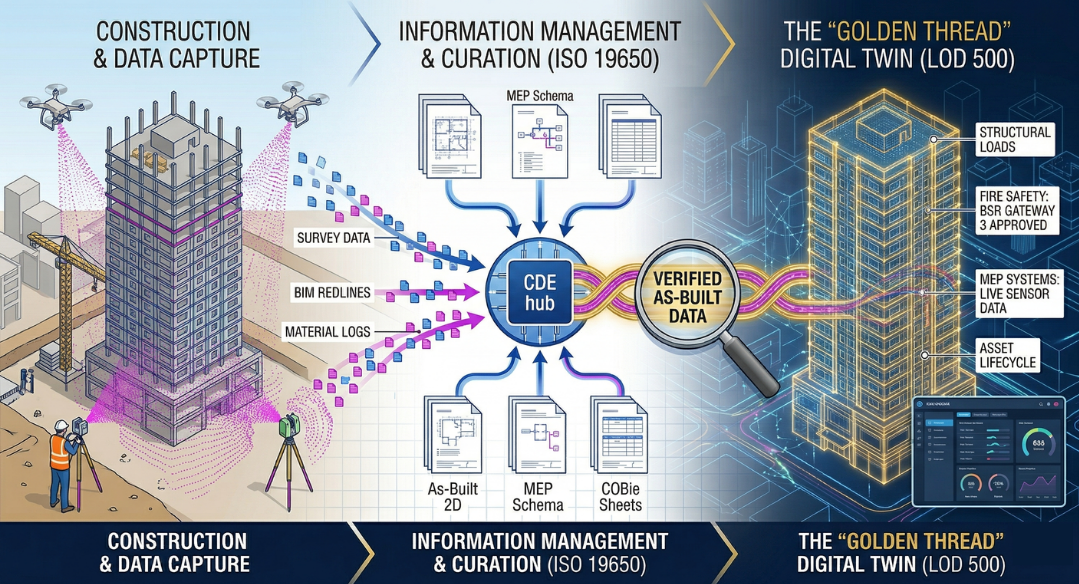
For “Higher-Risk Buildings” (HRBs) in the UK, the Building Safety Regulator requires evidence of a Golden Thread—a digital record of how a building was designed and built. An accurate as-built model created via Scan to BIM provides the forensic evidence needed at “Gateway 3” (Completion) to prove that the building, as constructed, matches the fire safety and structural designs approved at earlier stages.
02.Technical Verification: The RICS & ISO 19650 Standards
To meet UK industry standards, as-built drawings must align with RICS (Royal Institution of Chartered Surveyors) guidance for measured surveys. This ensures that the Point Cloud to BIM process follows a rigorous “Survey Control” methodology. Furthermore, information must be managed within a Common Data Environment (CDE) as per BS EN ISO 19650-3, ensuring data is authorized and structured for the asset’s operational life.
03.The Definitive UK Client’s As-Built Checklist
When a contractor or BIM service provider issues as-built deliverables, UK clients should conduct a “Deep Dive” audit using this specific checklist:
Coordinate System Alignment: Verify the model is georeferenced to the Ordnance Survey National Grid and the project’s specific site datum.
LOD 500 / LOIN Verification: Ensure elements meet the agreed Level of Information Need (LOIN), including geometry and structured data, capturing critical and “hidden” MEP routing.
Note: While “LOD 500” is commonly used in industry search terminology, the governing contractual standard under ISO 19650 in the UK is the Level of Information Need (LOIN). Both must be clearly aligned in project delivery requirements.
Deviation Report (Point Cloud vs. Model): Request a report showing the tolerance between the laser scan data and the final BIM model (typically within ±15mm to ±25mm).
Fire Safety & CDM Compliance: Ensure drawings identify fire-stopping locations, emergency exits, and residual hazards as required by CDM 2015 regulations.
Asset Naming & Metadata: Check that all equipment follows the Uniclass 2015 classification system for standardized identification.
04.Integrating COBie for Operational Excellence
The true value of an as-built BIM model lies in its data portability. COBie (Construction Operations Building information exchange) acts as the data schema that migrates information from the construction model into the client’s CAFM (Computer-Aided Facility Management) system. A technical as-built service must ensure that every commissioned asset in the model – from HVAC units to fire dampers – contains the correct metadata (manufacturer, warranty, and maintenance schedules). This integration eliminates the “manual data entry” phase post-handover, allowing facility managers to achieve operational excellence from Day 1.
Conclusion
For the modern UK client, as-built drawings are the primary insurance policy against operational failure and legal non-compliance. By leveraging Scan to BIM services and following a rigorous technical checklist, stakeholders ensure that their “Digital Twin” is an honest reflection of the physical asset. This precision satisfies regulators and provides the foundation for cost-effective facility management and future-proofed asset value.
A failed Gateway 3 audit can halt your entire project
An Emerging International Business Developer in the AEC Industry. Shankar is a Mechanical Engineer from India with a specialization in Mobility Engineering from the esteemed Politecnico di Milano University, Milan, Italy. Shankar is dedicated on exploring business opportunities in the Built Environment / BIM. He focuses on International Business Development Operations globally. He supports Team Conserve by Introducing New Client, Project Collaborations, Brand Awareness, New technology tool integrations and New Portfolio Creations.