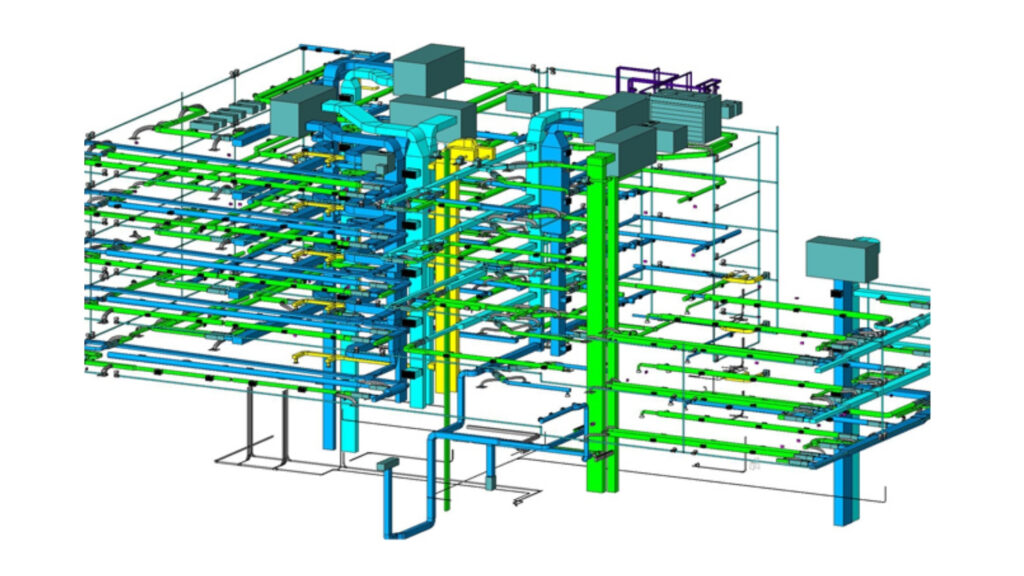
BIM coordination is one of the most critical – and most consistently mismanaged – processes in UK construction. On paper, it promises a single, clash-free federated model that every discipline can build from with confidence. In practice, on projects across London, Birmingham, and Manchester, it too often delivers a clash report that nobody acts on, a Navisworks model that is out of date before it is issued, and on-site conflicts that were entirely avoidable. This article examines why BIM coordination fails, what the structural causes are, and what project teams can do to fix them before the programme pays the price.
In this Blog:
Key Takeaways
Why BIM Coordination Fails at Process Level
The On-Site Cost of Poor Coordination
Practical Fixes That Actually Work
Conclusion
01. Key Takeaways
Coordination is a process, not software
Assign named coordination ownership
Clash detection must be iterative
CDE controls model version integrity
Fix early, save programme later
BCF log ensures clash accountability
02. Why BIM Coordination Fails at Process Level
BIM coordination failures are rarely a technology problem. Navisworks and Revit are mature platforms. The failure is almost always a process failure – and it manifests in three predictable ways.
Clash detection treated as a one-time event
A single clash report issued at RIBA Stage 3 or 4 is not coordination – it is a snapshot. Design evolves. If clash detection is not repeated as the model develops, and if resolution is not tracked and re-checked after changes, the report becomes a historical document with no live relevance to what is being built.
No defined ownership of the coordination process
On many UK projects, nobody is formally appointed as BIM Coordinator or Information Manager. The architect assumes the structural engineer is managing the federated model. The structural engineer assumes the MEP subcontractor is coordinating their own work. Without a defined Task Team structure under BS EN ISO202419650, coordination defaults to whoever shouts loudest.
Models issued without a CDE workflow
Issuing models by email or shared drives bypasses the information state controls a CDE provides. Without WIP, Shared, Published, and Archived states, teams cannot know which model version is current. Discipline models get coordinated against superseded geometry. The coordination effort is wasted.
03. The On-Site Cost of Poor BIM Coordination
When coordination fails digitally, the consequences are physical and financial on site. Unresolved clashes between MEP services and structural elements are among the leading causes of variation orders on UK commercial and healthcare projects. A duct that was never coordinated against a beam does not cost the price of a coordination round — it costs redesign, re-procurement, re-installation, and the programme delay that compounds every following trade.
On central London projects – compressed floor-to-floor heights, restricted hours, no margin for error – a single unresolved MEP clash can halt installation on an entire floor for days. In Birmingham and Manchester, tight developer programmes magnify the same effect. The coordination skipped to save two weeks in design costs four weeks on site.
The coordination cost equation
Resolving a clash in the BIM model costs minutes. Resolving the same clash during installation costs multiples of the original coordination budget -— and that does not include the knock-on programme impact to following trades.
04. Practical Fixes That Actually Work
The good news is that BIM coordination failures are entirely preventable. The fixes are not technical. They are structural, contractual, and behavioural — and they can be implemented at any project stage, though the earlier the better.
Fix 1: Appoint a BIM Coordinator at project outset
Under BS EN ISO202419650, every project should have a named Appointed Party and Task Teams with defined responsibilities per discipline model. Where this is not contractually mandated, appoint a BIM Coordinator explicitly – a named individual with authority to call coordination meetings, freeze models for review, and escalate unresolved clashes to the project manager. Coordination without ownership is coordination in name only.
Fix 2: Run coordination as a live, iterative process
Establish a coordination cadence from the start of detailed design — fortnightly federated model reviews, all discipline leads present, a BCF issue log updated at every session, and clashes assigned to a named owner with a resolution deadline. The model freeze date must be agreed and enforced: no design changes accepted after that point without formal change control.
Fix 3: Use the CDE properly
All discipline models must be issued through the CDE, not shared informally. Each issue moves through WIP, Shared, and Published states with review and approval at each gate – ensuring coordination is always carried out against the current, approved version of each model, not a file emailed last Tuesday that may already be superseded.
The coordination cost equation
A coordinated federated model issued at RIBA Stage 4 with a zero hard-clash status, a complete BCF log showing every clash raised, assigned, resolved, and verified — and a model freeze certificate signed by all discipline leads. That is the standard. It is achievable on every project.
A failed Gateway 3 audit can halt your entire project
BIM coordination fails not because the tools are inadequate, but because the process around them is undefined or treated as a one-time deliverable. Under BS EN ISO202419650, the framework already exists – EIR, BEP, CDE, Task Teams, model freeze milestones. Projects that use it properly deliver federated models contractors can build from without a site-level correction exercise.
The impact is direct: fewer variation orders, shorter RFI cycles, reduced re-installation costs, and a programme that holds. As 3D coordination and construction-phase BIM become baseline expectations on UK major schemes, the ability to manage coordination as a professional discipline – not an afterthought – will define which project teams are worth appointing.
Is BIM Coordination a Challenge on Your Current Project?
Conserve Solution provides BIM coordination services across London, Birmingham, Manchester, and the wider UK – from clash detection through to construction-ready federated model delivery under BS EN ISO 19650.
Tell us your project stage and we will respond within 24 hours
An Emerging International Business Developer in the AEC Industry. Shankar is a Mechanical Engineer from India with a specialization in Mobility Engineering from the esteemed Politecnico di Milano University, Milan, Italy. Shankar is dedicated on exploring business opportunities in the Built Environment / BIM. He focuses on International Business Development Operations globally. He supports Team Conserve by Introducing New Client, Project Collaborations, Brand Awareness, New technology tool integrations and New Portfolio Creations.